Tag: Reinhart

  • Bagels for Breakfast!

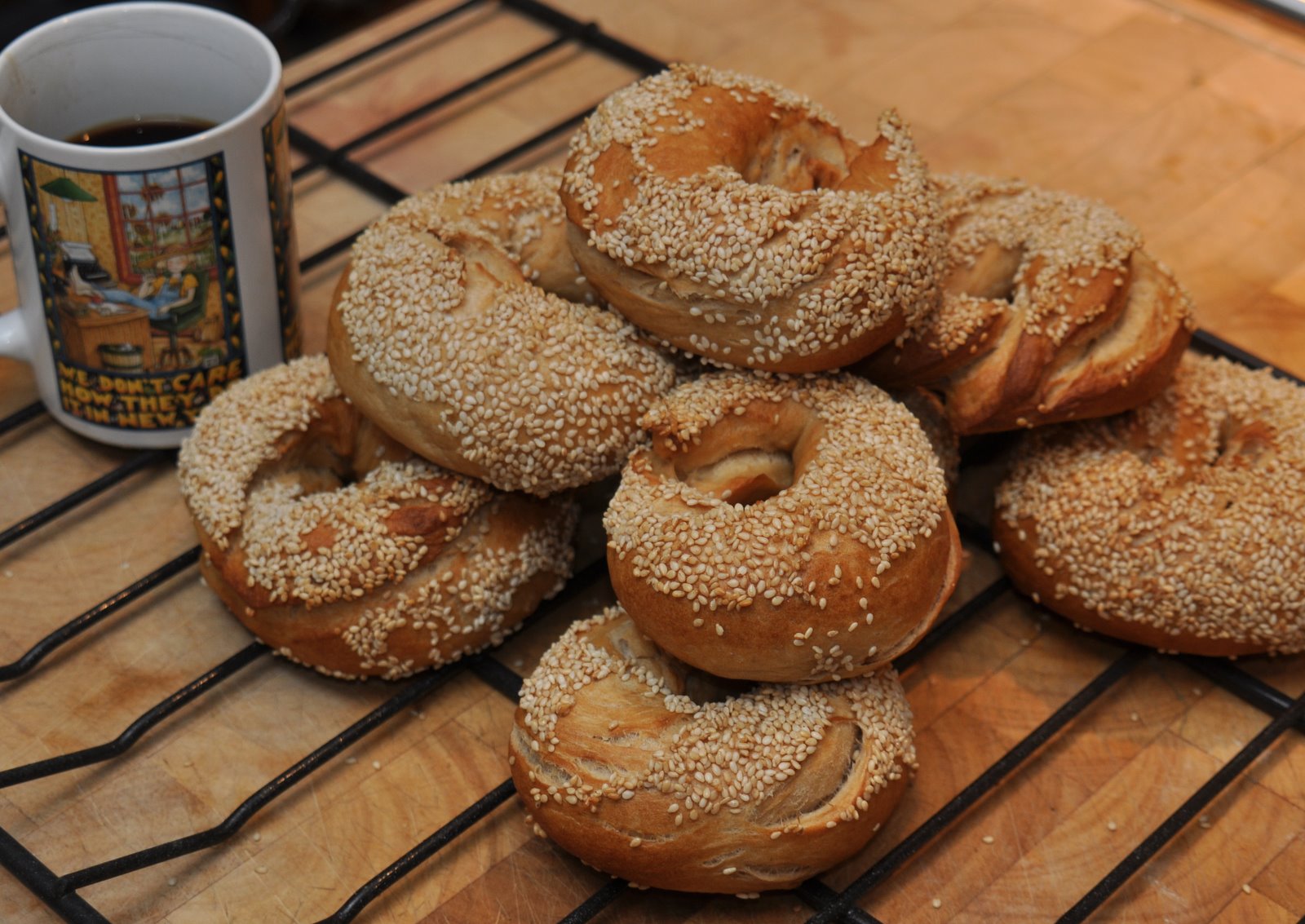
    Back in the day, my mother was a nurse in Miami, Florida. My dad would fly down there periodically for a visit and on his return trip, he’d sometimes bring me a couple dozen very good bagels. I remember one time in particular, he not quite understanding the allure of a well made bagel (or any other kind), and with his suitcase nearly full, he managed to flatten two dozen bagels to the point where they looked like frisbees. But we enjoyed them anyway.

    At that time, before the Internet and the plethora of exellect baking books available, I thought making a bagel at home was impossible. There must be some magic to it, or why wouldn’t everyone do it?

    Which brings us up to this morning. I had these bagels already formed and in the refrigerator for an overnight ferment. I took them out and put them on the kitchen table around 3 AM so they’d be at the right temperature for the boiling phase. And then I overslept.

    I came downstairs to find the bagels were so overproofed, that I couldn’t even pick them up. There was nothing else to do except roll it all back together again, divide, and reshape. By this time, I already had the water at full boil and the oven was up to temperature. I had no idea how these would come out, if at all.

    This once again illustrates that even when you make a few mistakes (adding too much salt, not being one of them…), home baking results in a product that is very difficult to find at the grocery store. Here in Kansas City, and in many other large communities, it is quite possible to find a decent bagel. But even with the mistakes I made this morning, I really think these are better than anything around here.

    The malt syrup used in this recipe is available at Whole Foods. I used a pretty standard hydration and the formulation and methods (well, sort of…) from Peter Reinhart’s, Artisan Breads Every Day.

    Posted by Picasa
  • Steam power!


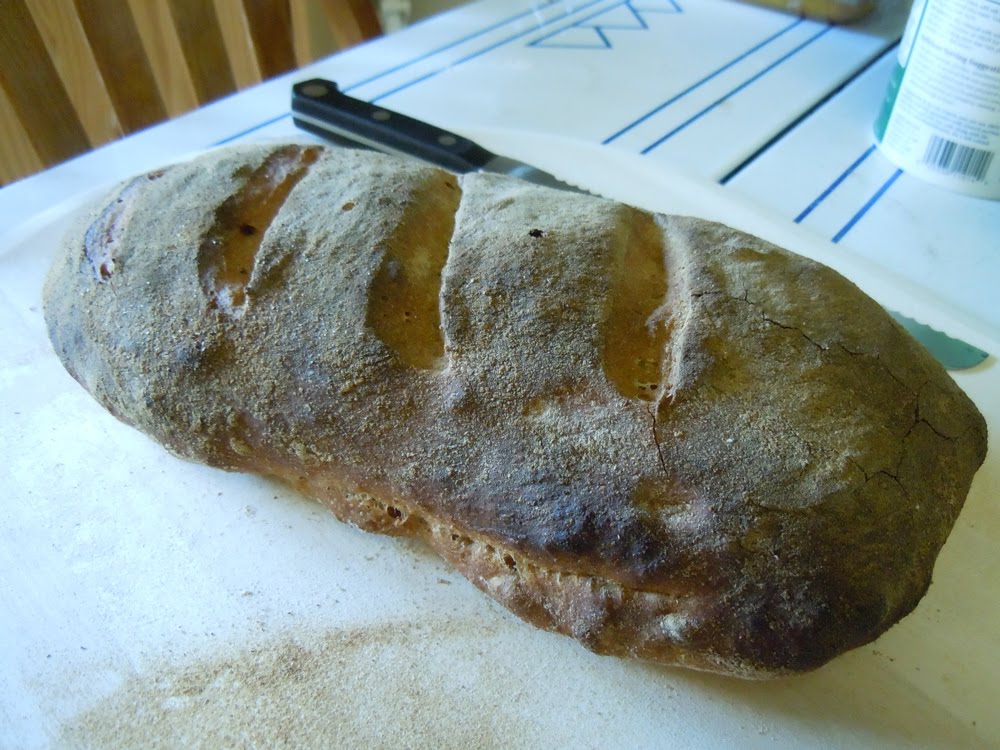
    I baked my second loaf using the oven stone this morning, and as I was getting ready to put the dough in the oven, I remembered Dad saying something about “misting the oven.” This is a step I haven’t taken before, and I’ve noticed a couple things.

    First, when I’ve made loaves in the dutch oven – which helps retain more humidity around the loaf when you have the lid on for the first 2/3 of the bake – the resulting crust is…well, quite crusty (in a good way).

    When I’ve made loaves without the dutch oven, either cooking them on a baking sheet or on the oven stone, the crust is much thinner and softer.

    So I thought, perhaps this “misting” step is important for the crusty crust.

    I didn’t have a mister, but looking in Peter Reinhart’s “Artisan Breads Every Day,” I found the author suggested one can also use a “steam pan” to add humidity to the oven. He recommends adding hot water to a pre-heated steam pan (below the oven stone – be careful not to spill water on the stone) just before putting the dough in the oven.

    Since I was in a hurry, and not reading the directions that carefully (like, how much water?) I put cold water into a baking sheet that just happened to be pre-heated under my stone (lucky break, I often store pans in the oven for lack of cupboard space). It created quite a blast of steam and warped the pan so much I thought I might have a spill. (A little more water and the pan un-warped). Then I closed the door and waited another five minutes or so before putting the dough in (should I have done it right away when there was more steam?)

    The bread that finally came out was indeed more crusty – somewhere between the dutch-oven bread and the no-steam/no-dutch-oven bread. Also, I had to let the surface get quite dark before the internal bread temp finally crested 180 with ease – when I put the thermometer in the first time, the dial virtually crawled from 175 to 180.

    After cooling, I cut into the first couple inches. Crust aside, the inside looked good. A bit more dense, particularly toward the bottom, but this was a 50/50 whole wheat dough. I’ll add some pictures soon.

  • Today’s Bagel is Brought to You By the Letter C

    Baking is so much different than cooking. With cooking, you can pretty much throw anything into a pot, let it simmer, taste it now and again, maybe with a glass of wine or two, and adjust the seasoning as you go along. With baking, you really need to focus on technique, and precise measurements.

    Yesterday I made the dough for baking some bagels this morning. Reinhart suggests the following steps:

    • Mix the dough
    • Let rise
    • Shape into bagels
    • Proof
    • Retard in the refrigerator
    • Just before baking, bring them up to room temperature
    • Boil
    • Bake

    Sounds pretty simple. However, I did it differently. Given that I needed to get out of bed at 3:30 to get them baked in time for work, I elected to leave the dough at a cool room temperature (about 65 degrees) for the night. So, basically, I’ve let the dough proof quite a bit before shaping them into bagels early this morning.

    First off, the bagels are cinnamon raisin with walnuts. My sister likes walnuts in her bagels. (She isn’t anywhere around here, so what difference that makes, I’m not sure…) As a result of the overnight proof, the dough was quite soft. My attempt to roll the dough into a “snake” was an issue because the walnuts and raisins created holes and cavities in the dough. As a result, I basically squeezed them into shape. The wrap-around-the-hand-and-roll-together step wouldn’t work. So, again, the ends sort of got squeezed together.

    During the boiling and baking process, half of the bagels separated at the seam, forming the letter C as a result.

    I’m reasonably confident they will taste OK. But next time, I might actually follow the directions.