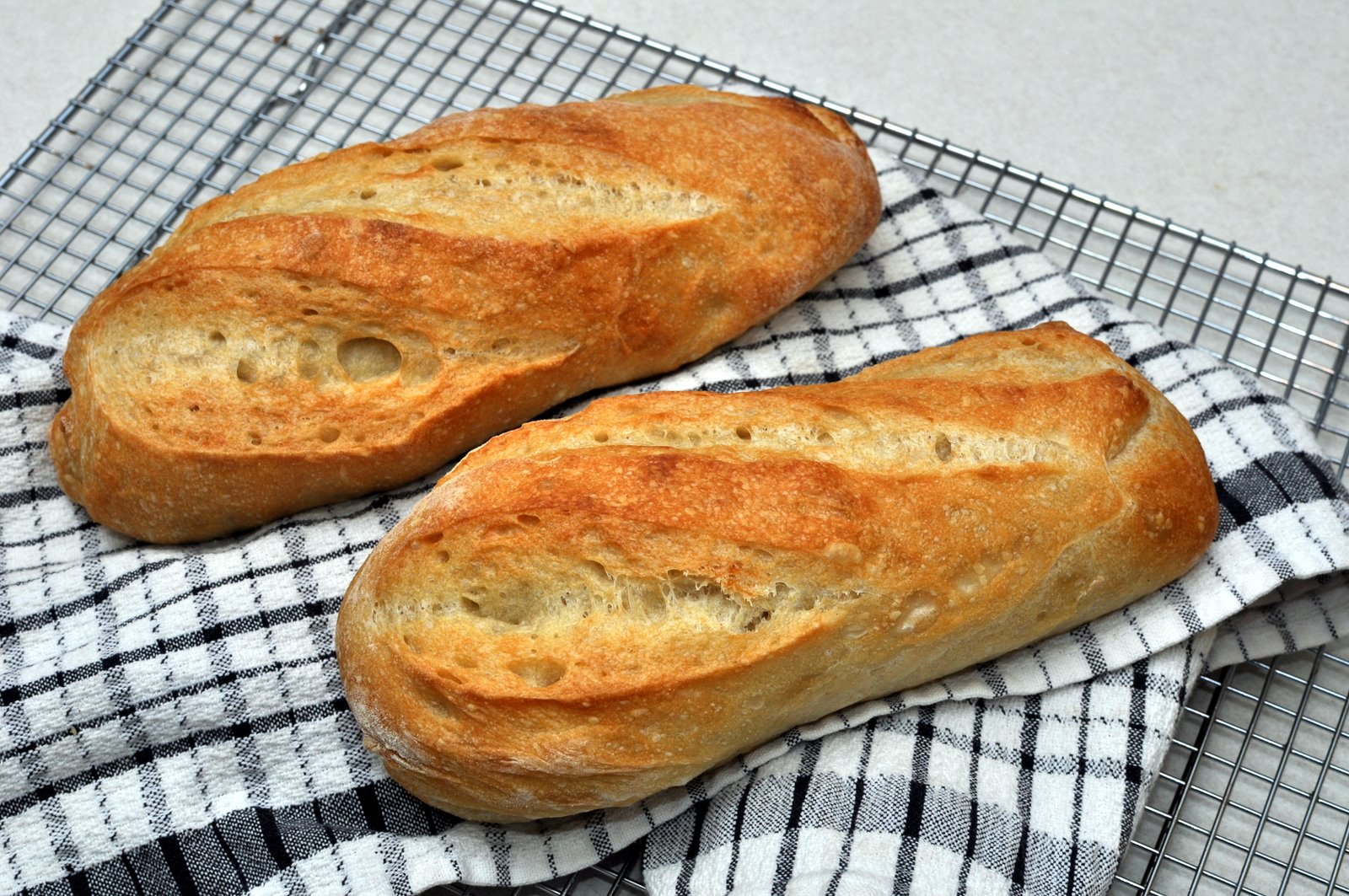
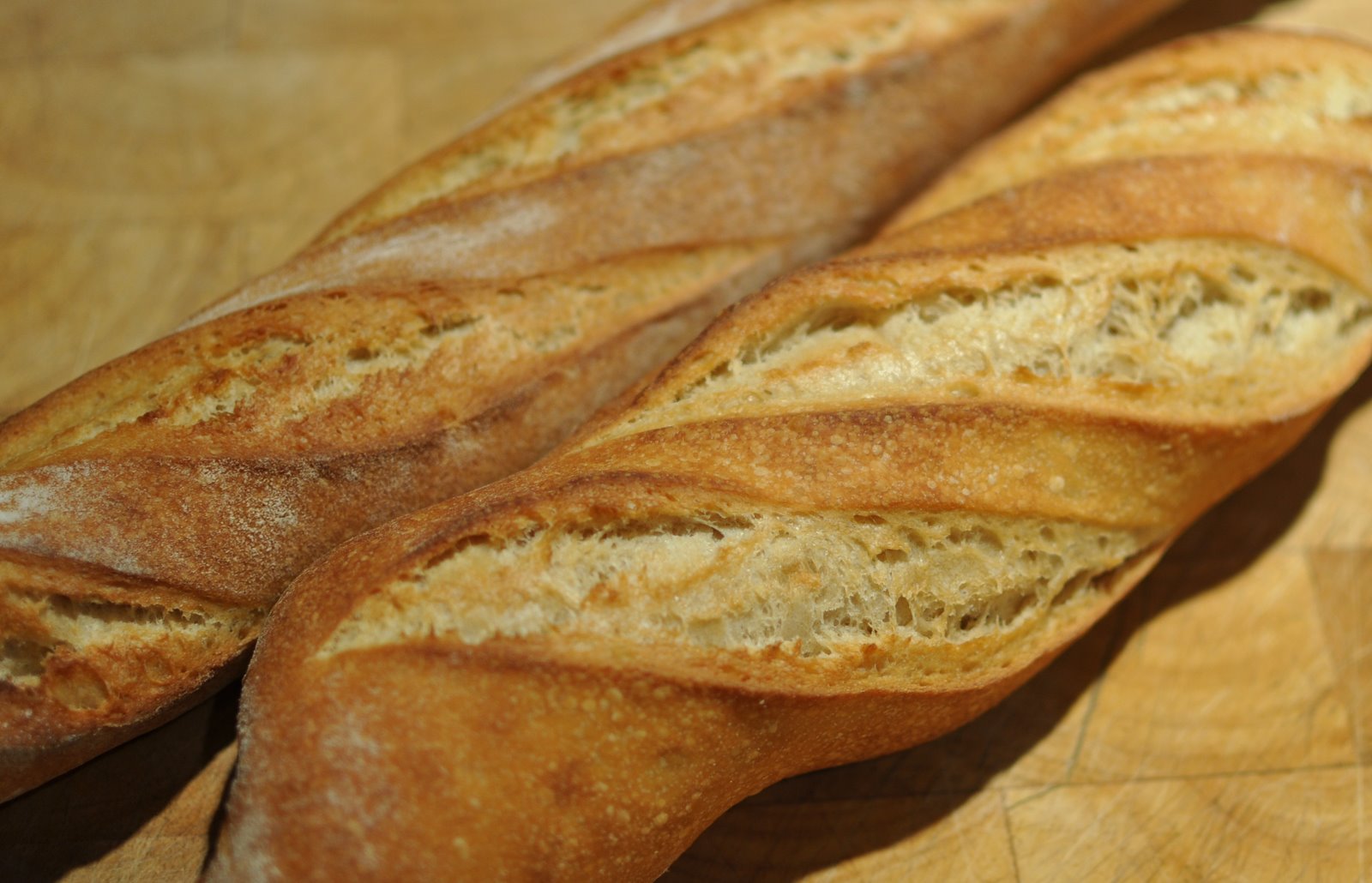
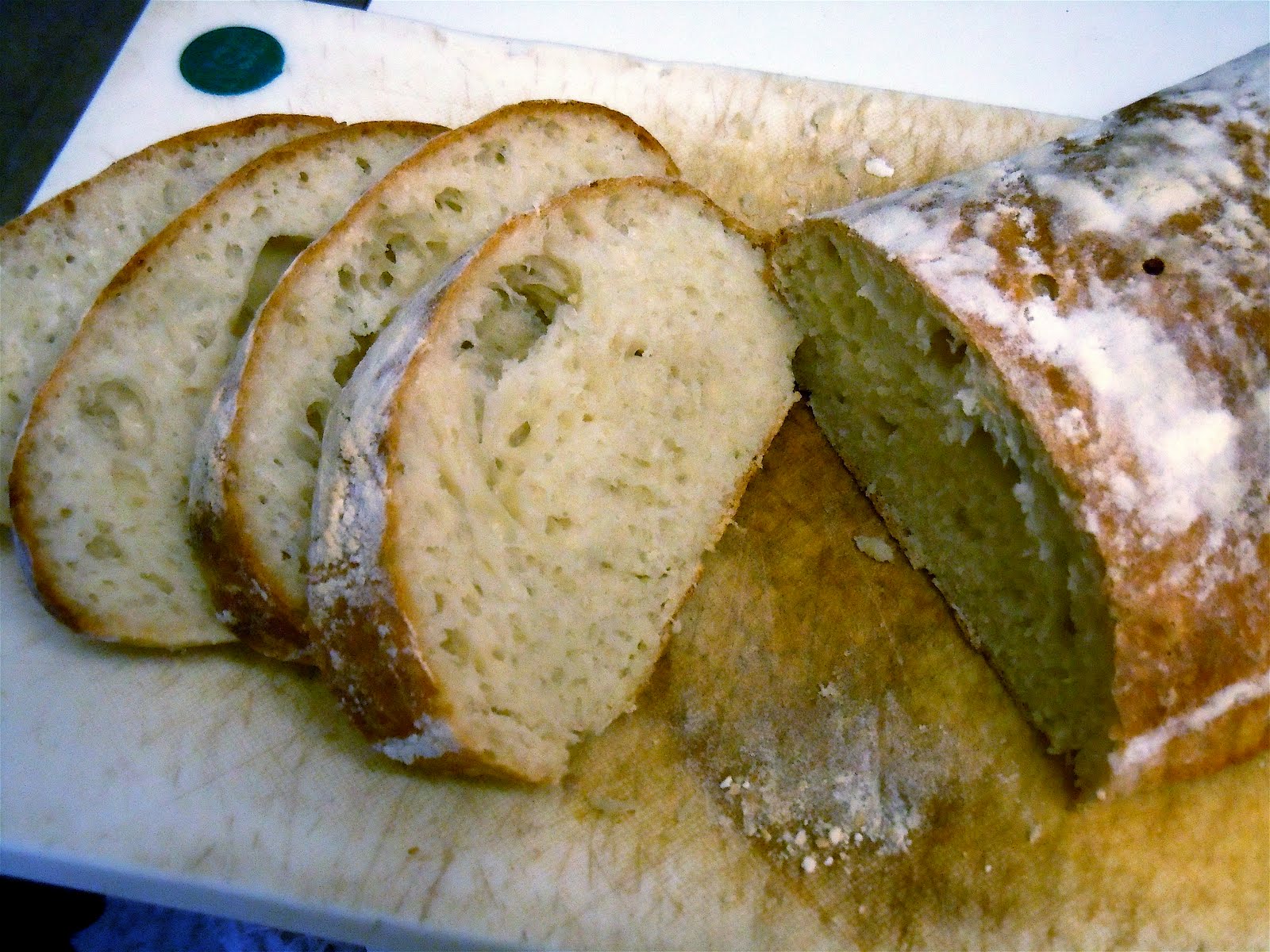
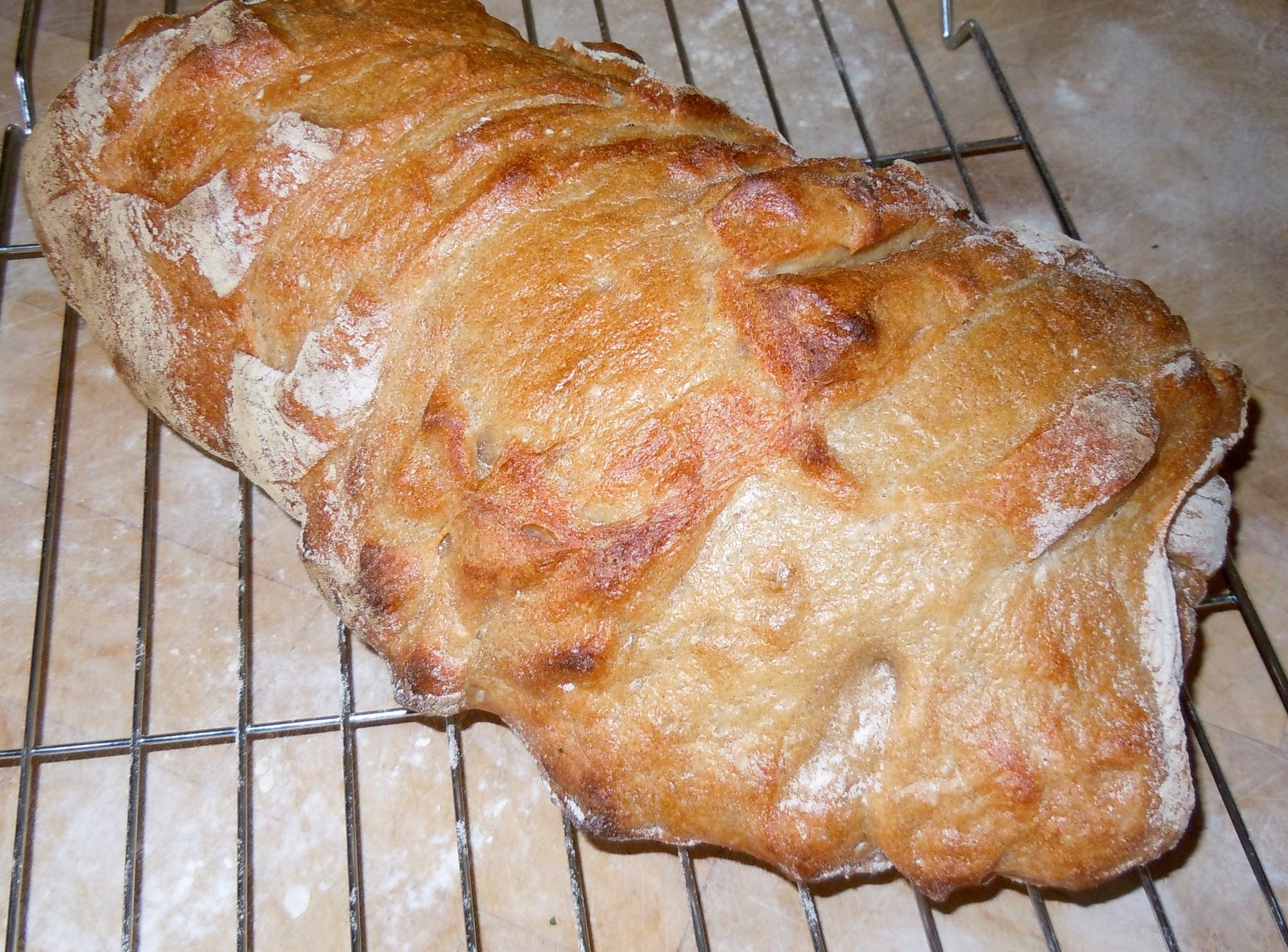
My dear sister will be returning from her world travels anytime soon! Last I heard she was in London after finishing a safari in Tanzania and a short stop to Cape Town, South Africa. Welcome back, Sunny! These are just for you! Made with KAF, Sir Galahad. Many thanks to the local Hy-Vee bakery manager, Jayme for the flour!
Tag: Batard
-
Daily Batard
Here are a couple of loaves that just came from the oven this morning. I used 75% hydration and started with a poolish with 100% hydration, just flour and water of equal weights.I used the Eagle Mills All Natural All-Purpose Unbleached Flour from Costco. Having recently baked with King Arthur Unbleached White, I had forgotten how much heavier this flour is. However, it delivers a wonderful (and healthy) loaf.
Good stuff!
-
Steam Power! Part 2


This is my second loaf using the steam pan method, putting the water in the pan after the dough is in the oven, as suggested; plus a refresher steam ten minutes later. This dough was never in the fridge so it was thoroughly at room temperature when it started baking. Plus, this dough was only about 33% whole wheat. Those factors all combined produced a much more buoyant loaf. -
Steam power!

I baked my second loaf using the oven stone this morning, and as I was getting ready to put the dough in the oven, I remembered Dad saying something about “misting the oven.” This is a step I haven’t taken before, and I’ve noticed a couple things.First, when I’ve made loaves in the dutch oven – which helps retain more humidity around the loaf when you have the lid on for the first 2/3 of the bake – the resulting crust is…well, quite crusty (in a good way).
When I’ve made loaves without the dutch oven, either cooking them on a baking sheet or on the oven stone, the crust is much thinner and softer.
So I thought, perhaps this “misting” step is important for the crusty crust.
I didn’t have a mister, but looking in Peter Reinhart’s “Artisan Breads Every Day,” I found the author suggested one can also use a “steam pan” to add humidity to the oven. He recommends adding hot water to a pre-heated steam pan (below the oven stone – be careful not to spill water on the stone) just before putting the dough in the oven.
Since I was in a hurry, and not reading the directions that carefully (like, how much water?) I put cold water into a baking sheet that just happened to be pre-heated under my stone (lucky break, I often store pans in the oven for lack of cupboard space). It created quite a blast of steam and warped the pan so much I thought I might have a spill. (A little more water and the pan un-warped). Then I closed the door and waited another five minutes or so before putting the dough in (should I have done it right away when there was more steam?)
The bread that finally came out was indeed more crusty – somewhere between the dutch-oven bread and the no-steam/no-dutch-oven bread. Also, I had to let the surface get quite dark before the internal bread temp finally crested 180 with ease – when I put the thermometer in the first time, the dial virtually crawled from 175 to 180.
After cooling, I cut into the first couple inches. Crust aside, the inside looked good. A bit more dense, particularly toward the bottom, but this was a 50/50 whole wheat dough. I’ll add some pictures soon.
-
Straight from the oven, daddy-o…

Made the bread pictured here this morning from all-white dough that I’d had in the fridge for a day. 70% hydration.Proofed at room temperature for about two hours on lightly oiled parchment paper.
Slid parchment paper right onto inverted aluminum baking sheet in the oven and baked at 500 degrees for 25 minutes.
Cooled for 1/2 hour before cutting.
Final result – nice chewy/creamy texture with large crumb and some good holes. Very soft, but not doughy at all. Thin, soft, well browned crust. Not as crusty as dutch oven loaves I’ve made, but very good nonetheless.
-
Ugly Bread
People have been making bread since
the stone age. Of course, with better equipment and knowledge, it gets better all the time. Up to a point. Most of today’s store-bought breads, made in factories across the country, sliced and ready to eat, are barely recognized as food to the artisan bakers, let alone a good source of nutrition.With our busy schedules, an easy solution is to stop at the grocery store and pick up a loaf when you didn’t plan ahead. A loaf of decent bread costs anywhere between $2 to $5. Further, it gets stale quickly and has little flavor.
Last week I made some dough and didn’t follow through according to best practices. I didn’t have the right size bowl available, and it was too large to fit in the refrigerator, especially along with all the other stuff already in it. So, I left it on the countertop covered with plastic wrap which is acceptable for reasonably short periods of time. I can only say I got lazy and didn’t plan ahead.
When I returned from work, I found the dough busting out over the top of the bowl and generally making a mess. I punched it down and split it into two batches. With the first batch, I made some pita bread and a couple of small baguettes. They didn’t come out too badly, but certainly nothing worthy of a magazine shoot.
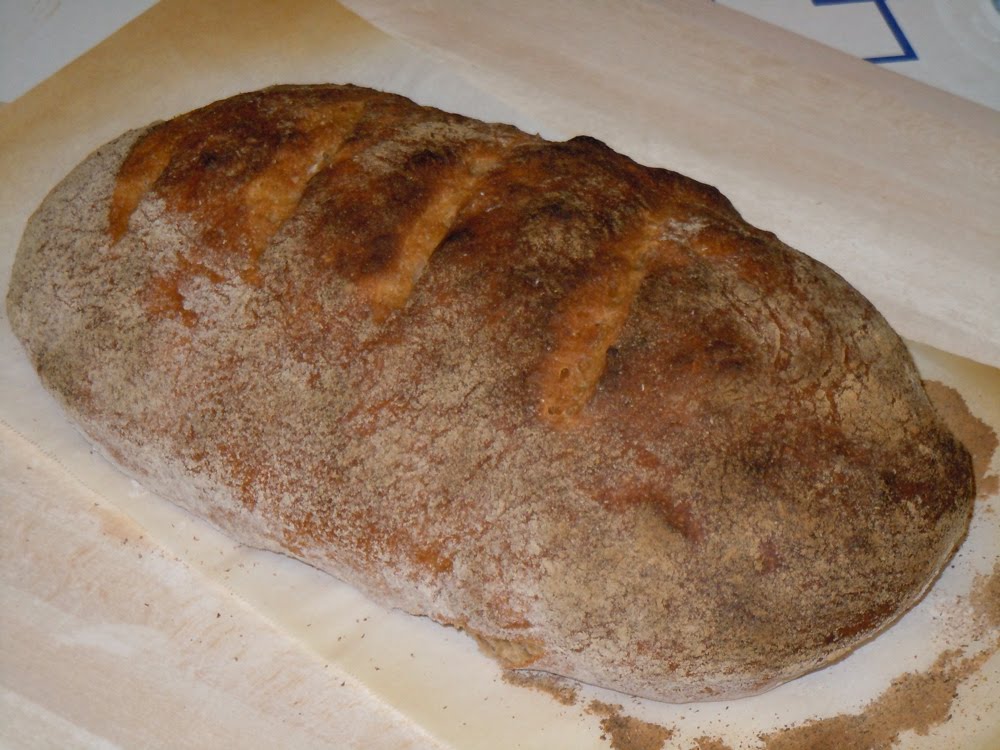
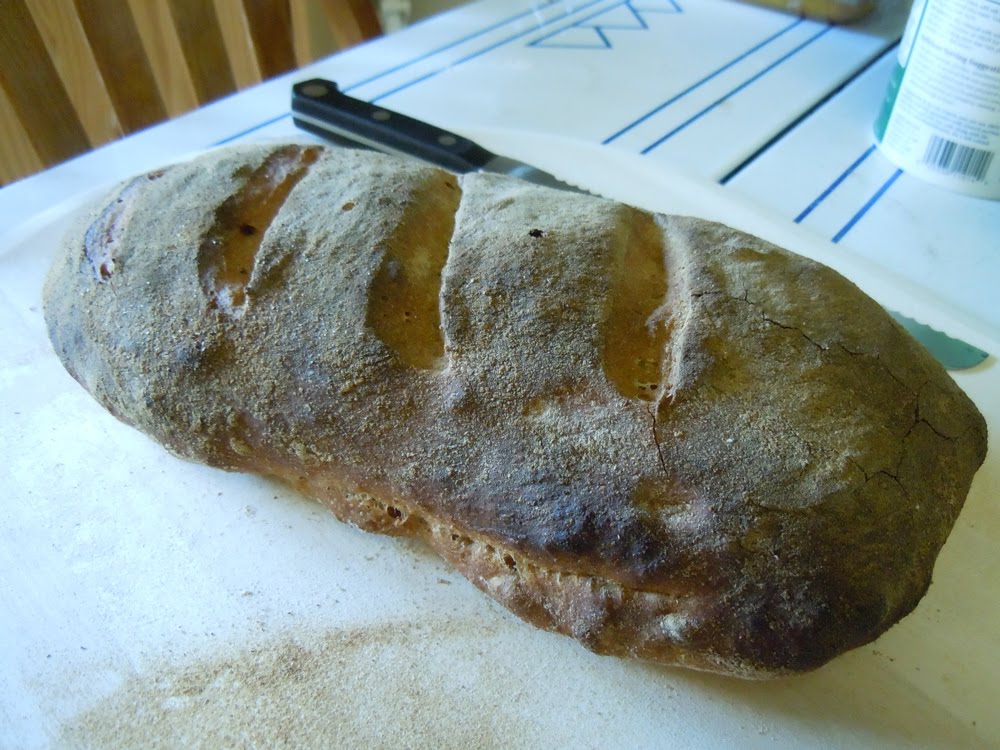
Yesterday afternoon, we decided on spaghetti for dinner and I thought I’d try to use the remaining dough, now a week in the frig, to make some bread for dinner. I mixed it with a fresh batch and after a couple of hours, it was somewhat usable. The picture here is of the remaining loaf. We ate most of the first one and had the rest of it toasted this morning. It was better than any bread you can buy in the store. But was it ever ugly!
So, here is my point. People have been making bread for 12,000 years. Without thermometers. Without kitchens. Without electric or gas ovens. Without precise measuring devices or fresh water on tap, without salt, without store-bought yeast. On rocks. Sure. The first breads were not much more than a paste poured out onto a rock and left in the hot sun. But for hundreds of years, people have been making great bread without any of the conveniences we have today. And they were great, nutritious breads.
Today we have cookbooks with color pictures and step-by-step instructions. We have YouTube videos that show the entire process. And you only need four ingredients, flour, water, salt, and yeast. Four (4). No more. No less.
- 3 cups of flour
- 1 cup of water
- 1 1/2 teaspoons of salt
- 1 teaspoon of yeast.
That is about thirty cents worth of stuff. Maybe less.
And yet, there is this fear of failure. What if I don’t mix it right? What if it doesn’t rise? What if? What if?
With today’s quality ingredients available nearly everywhere, you really can’t get this wrong. It might not be perfect. It might be pretty ugly. You might not think it looks anything like what you’ve seen before. But, it will be better than anything you can buy in the store!
Make a batch of dough today. Make a loaf of bread tomorrow.
You’ll love it. And you’ll be loved for it.