Category: Lessons Learned

  • Preferment

    I know. What a mess. But this is what a preferment looks like. It is the beginning of all successful bread-making projects.

    Last night I was a bit restless and finally decided a fresh loaf of something yeasty might be good on a Sunday. Well, any day. And I hadn’t started my preferment. Not really wanting to stir from my comfortable slumber, I had to let that idea sink in for a while before I got up to mix together this combination of flour, water, and yeast. Here it is, roughly seven hours later, as I sip my first cup of coffee. I’m not sure what I’ll be making today. But this will make it better.

    Let’s not forget to add salt later in the day…

  • Plan Ahead With Large Bowls

    In preparation for today’s bread baking, I doubled my sourdough starter last night before heading up to bed. The picture at the right illustrates what I found this morning before coffee! It was covered with plastic wrap and didn’t make a mess, but it was close!

    So, remember to use a bowl big enough to contain whatever may happen during the night!
    Posted by Picasa
  • The Hasty Baguette

    Once again, this morning I’ve tested the concept that even a hastily prepared loaf of bread is better than none at all.

    When I got home from work on Wednesday, after having just provided chili and bread for a workplace birthday party, I decided it would be good to start another batch of dough. Now, as any baker knows, once the process has begun, you pretty much need to stay on a schedule or the bread won’t be as good as it could be.

    However, the forces of life tend to creep in and the schedule goes awry. Last night I had every intention of baking the bread, the oven already set to 550. Then one thing led to the next, got too tired, and headed up to bed. Around 4 AM this morning, I came down to an oven, still at 550 from last night (oops!), and the dough well proofed in my large ceramic bowl.

    It was time to either put this bread in the oven or forget the whole thing. There wasn’t enough time to scale and shape. So, I basically just divided the dough into reasonable sizes, did the best I could to shape them without degassing, and slid them into the oven in two batches.
    And once again, the baguettes wouldn’t win any prizes for looks, but they taste just wonderful. A very nice crumb and crust.

    Sometimes it pays to just put the dough in the oven and see what happens.

    Posted by Picasa
  • A video from Craig Ponsford

    While waiting for the sun to rise this morning, I happened to catch this video from the “Chow” network featuring the Chairman of the Bread Bakers Guild of America, Craig Ponsford. He has some pretty straightforward words for those of us striving to make the perfect loaf. Enjoy!

    I’m still making slow progress on the kitchen. One day, more loaves will come from it.

  • Ciril Hitz

    Ciril Hitz has a number of excellent instructional videos on baking techniques. Check them out! His cookbook is listed in the column at the right side of this blog. This video features shaping the loaves. I can smell if from here! Tonight I’m making a boule. Bagels in the morning! Stay tuned!

  • The Use of Non-Standard Measurements in Baking

    Following a mentality stimulating Skype session with John last night, I came to realize that some might not have understood my reference to a measurement in “US Buckets,” in a comment to Casey’s posting “Steam Power.” Further, since the US Bucket measurement is not in Wikipedia, the Gospel source of all information, let me explain.

    A bucket is a unit of volume, though it is considered generally informal. In the U.S., many commodities (both wet and dry) are sold in plastic buckets holding 5 U.S. liquid gallons (about 18.927 liters). Now that I live in Texas, which is a big state and we know that everything in Texas is big, it makes perfect since to use large, very large, measuring devices. If my kitchen could accommodate a barge, which is equivalent to 1.34E+08 ounces, living in Texas, I would have defaulted to that.

    Since I have no scruples, let me continue. Since this blog is beginning to generate numerous postings, I believe it will not be long until it goes international. Thus understanding other units of measurements are important. For instance, if a Brit said he used 96 scrulpes of water to increase the atmospheric moisture level in his over, for baking bread, of course, then we should understand that that is equivalent to 4 ounces of water.

    3 fluid scruples= 1 fluid drachm= 60 minims
    8 fluid drachm= 1 fluid ounce

    I hope this has clarified my use of the measurement US Bucket and tonight while I am talking about technical interests with my friend John, I will be enjoying 4 gills of beer.

  • Notes On Flour

    As I have stated in previous posts, the flour I’ve been using is from Costco. It is:

    1. Unbleached
    2. High in fiber (a large percentage of whole wheat)
    3. Inexpensive
    4. Bakes into a nice loaf
    5. Tastes good
    So, what is this mysterious flour? It is called “Eagle Mills” which is manufactured with a specially ground flour (extra fine whole wheat) called Ultragrain®. You can learn more about it at this website, including where to buy it. Costco has it packaged in two 10 lb bags.
     
  • Methods from Jeff Hertzberg and Zoë François

    Here is some information worthy of a repost. I have their bread book. They also have a number of YouTube videos. This one is from Mother Earth News.

  • Choosing the Right Water

    In the nineteen-ninety-two movie, Scent of a Woman, LtCol. Frank Slade, while dinning at the Astoria, commented about the bread.

    Colonel Slade —
    Try one of these rolls, Charlie.
    I buttered it for ya.

    – Bread’s no good west of the Colorado.

    – Water’s too alkaline.

    Is the Colonel correct?
    Since it would be impossible to produce a loaf of bread without water, water being a basic ingredient, then perhaps choosing your water is as important as choosing the flour.

    Through a bit of research this is what I discovered. We can classify water several ways, hard, soft, alkaline, or acidic. Soft water weakens the gluten during mixing and fermentation. (This can be corrected by slightly increasing the salt.) Alkaline water not only weakens the gluten but retards the fermentation thus is considered the most harmful. Slightly acidic water will let the yeast perform at its best. Thus, hard water that is slightly acidic will yield the best bread.

    So, Lieutenant Colonel Frank Slade’s statement is correct.

  • Ugly Bread

    People have been making bread since the stone age. Of course, with better equipment and knowledge, it gets better all the time. Up to a point. Most of today’s store-bought breads, made in factories across the country, sliced and ready to eat, are barely recognized as food to the artisan bakers, let alone a good source of nutrition.

    With our busy schedules, an easy solution is to stop at the grocery store and pick up a loaf when you didn’t plan ahead. A loaf of decent bread costs anywhere between $2 to $5. Further, it gets stale quickly and has little flavor.

    Last week I made some dough and didn’t follow through according to best practices. I didn’t have the right size bowl available, and it was too large to fit in the refrigerator, especially along with all the other stuff already in it. So, I left it on the countertop covered with plastic wrap which is acceptable for reasonably short periods of time. I can only say I got lazy and didn’t plan ahead.

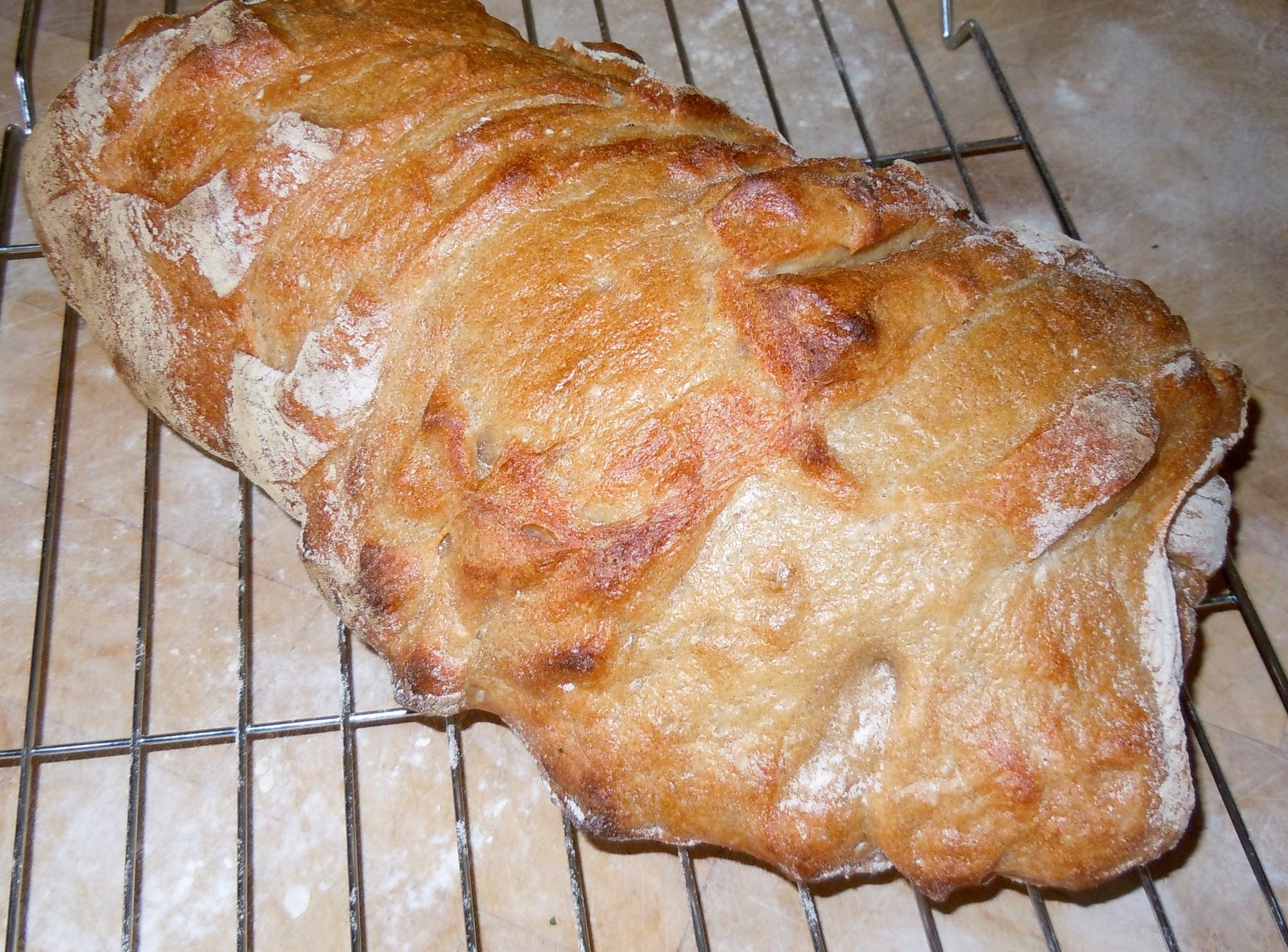
    When I returned from work, I found the dough busting out over the top of the bowl and generally making a mess. I punched it down and split it into two batches. With the first batch, I made some pita bread and a couple of small baguettes. They didn’t come out too badly, but certainly nothing worthy of a magazine shoot.

    Yesterday afternoon, we decided on spaghetti for dinner and I thought I’d try to use the remaining dough, now a week in the frig, to make some bread for dinner. I mixed it with a fresh batch and after a couple of hours, it was somewhat usable. The picture here is of the remaining loaf. We ate most of the first one and had the rest of it toasted this morning. It was better than any bread you can buy in the store. But was it ever ugly!

    So, here is my point. People have been making bread for 12,000 years. Without thermometers. Without kitchens. Without electric or gas ovens. Without precise measuring devices or fresh water on tap, without salt, without store-bought yeast. On rocks. Sure. The first breads were not much more than a paste poured out onto a rock and left in the hot sun. But for hundreds of years, people have been making great bread without any of the conveniences we have today. And they were great, nutritious breads.

    Today we have cookbooks with color pictures and step-by-step instructions. We have YouTube videos that show the entire process. And you only need four ingredients, flour, water, salt, and yeast. Four (4). No more. No less.

    • 3 cups of flour
    • 1 cup of water
    • 1 1/2 teaspoons of salt
    • 1 teaspoon of yeast.

    That is about thirty cents worth of stuff. Maybe less.

    And yet, there is this fear of failure. What if I don’t mix it right? What if it doesn’t rise? What if? What if?

    With today’s quality ingredients available nearly everywhere, you really can’t get this wrong. It might not be perfect. It might be pretty ugly. You might not think it looks anything like what you’ve seen before. But, it will be better than anything you can buy in the store!

    Make a batch of dough today. Make a loaf of bread tomorrow.

    You’ll love it. And you’ll be loved for it.

    Posted by Picasa