Category: Equipment
-
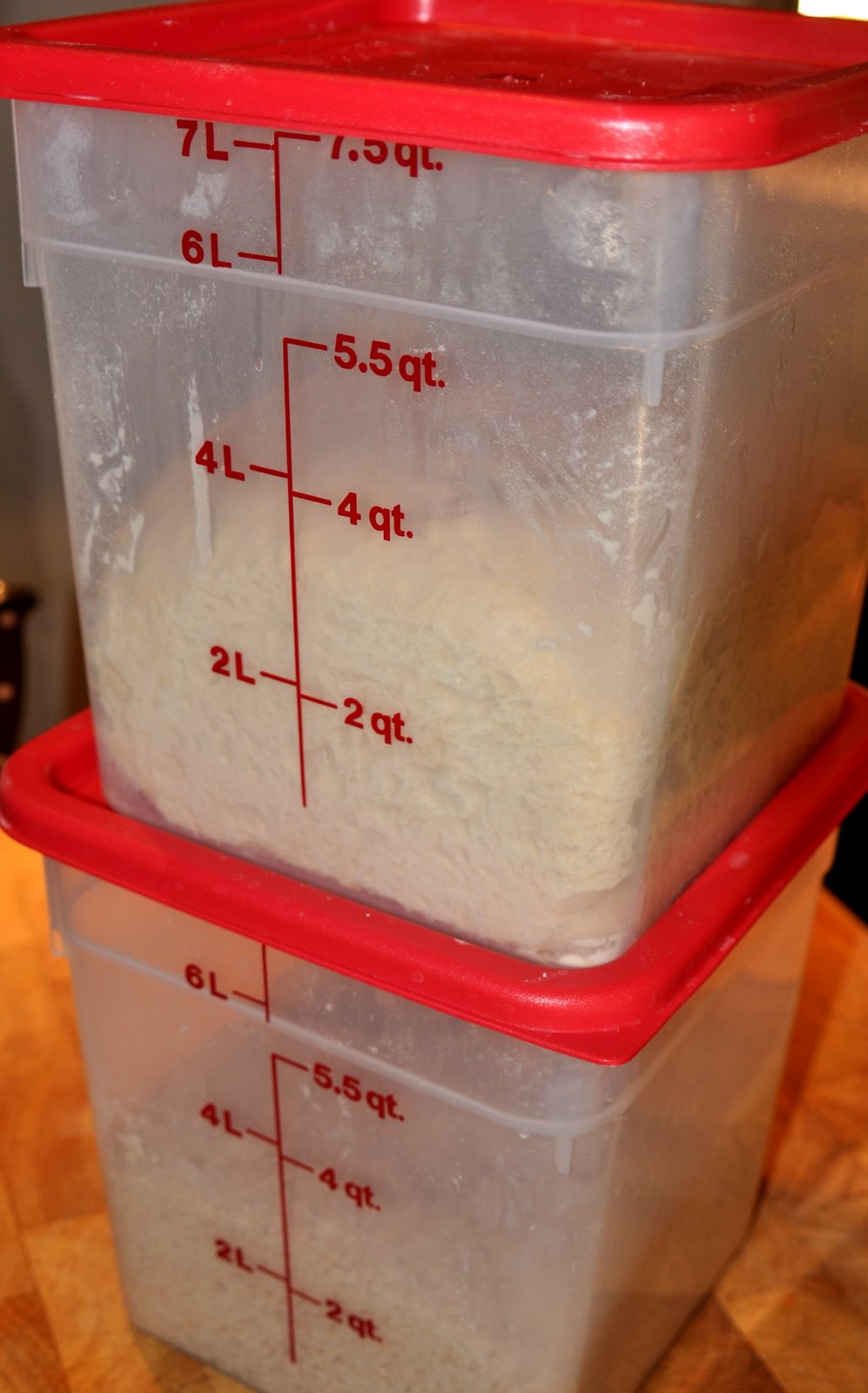
Dough Containers
 These convenient food containers were selected for a couple of reasons:
- They are food safe.
- The lids keep in the moisture but they are not air-tight.
- They are graduated for convenient reference.
- Translucent to visualize rising activity.
- Square footprint for more efficient storage.
These containers are listed among other tools used for baking in the right-hand column of this page.
-
Fibrament Baking Stone
One of the principles of artisan baking is to have a hot oven. Most ovens do not exceed 550 degrees and that is good for most of the loaves I’ve been baking. For thinner bread products, such as pizzas, pitas or focaccias, it would be better to have even a hotter oven, if you can get it. However the ordinary home oven, even pretty expensive ones, are not going to get you there.
So, what to do? One option is to install a wood burning oven in your kitchen or back yard. No matter how you slice it (excuse the pun…) that is expensive, if not impossible in many situations. But with that type of oven you can get temps in excess of seven or eight hundred degrees.
For those thin products, you also have the option of baking on a grill which, by the way, is a lot of fun. Some grills can approach those temperatures. But, again, that isn’t often the best of solutions for a number of reasons.
So, the next best thing to getting to those temperatures, is to retain the maximum temperature for as long as you can. The key to that is to have a large thermal mass to hold that heat in the oven as you open and close the door. For this reason, you’ll see a lot of baking stones sold in places such as Bed, Bath, and Beyond. Most of these are round and just a little bigger than a pizza, and frankly not all that thick (low thermal mass).
So, here is the stone to beat all stones for home (or commercial) ovens. I bought one of these a few months ago, and have since purchased them for some of my baking friends. Wow, major heat retention! Each stone is 3/4 inches thick and if you get one sized right for your oven, you should be able to bake a 2 or 3 loaves at a time. You can leave it in the oven nearly all the time (I have left it in during the cleaning cycle, because I forgot to take it out. But I’ll probably take it out in the future. The manufacturer says you can leave it in the oven with certain cautions.)
Make SURE you understand what size to get before you order it. The one I got is $70, but MEASURE before you order.
I’ll be buying a new oven soon, probably this week as a result of a kitchen remodel, and I’ll be getting another one of these for the second oven (double wall oven). And one of these days, I’ll get one for the gas grill also.
This is a good product. Shipping is included and arrives generally within the week.
-
Choosing the Right Water
In the nineteen-ninety-two movie, Scent of a Woman, LtCol. Frank Slade, while dinning at the Astoria, commented about the bread.
Colonel Slade —
Try one of these rolls, Charlie.
I buttered it for ya.– Bread’s no good west of the Colorado.
– Water’s too alkaline.
Is the Colonel correct?
Since it would be impossible to produce a loaf of bread without water, water being a basic ingredient, then perhaps choosing your water is as important as choosing the flour.Through a bit of research this is what I discovered. We can classify water several ways, hard, soft, alkaline, or acidic. Soft water weakens the gluten during mixing and fermentation. (This can be corrected by slightly increasing the salt.) Alkaline water not only weakens the gluten but retards the fermentation thus is considered the most harmful. Slightly acidic water will let the yeast perform at its best. Thus, hard water that is slightly acidic will yield the best bread.
So, Lieutenant Colonel Frank Slade’s statement is correct.